
Garage & Shop Heating
Garage Heater Installation & Repair
Grande Prairie
In Grande Prairie a heated garage is close to standard equipment. It is where the truck starts without a block heater, where the sled gets serviced in February, and where a project can carry on through a cold snap. Indoor Elements Mechanical installs and repairs gas-fired unit heaters in attached garages, detached garages, acreage shops and small commercial bays, and we have been doing it here for more than thirty years.
Sized for your building. Installed by licensed gas fitters. Permitted and inspected.


How They Work
Gas Unit Heaters For Garages And Shops
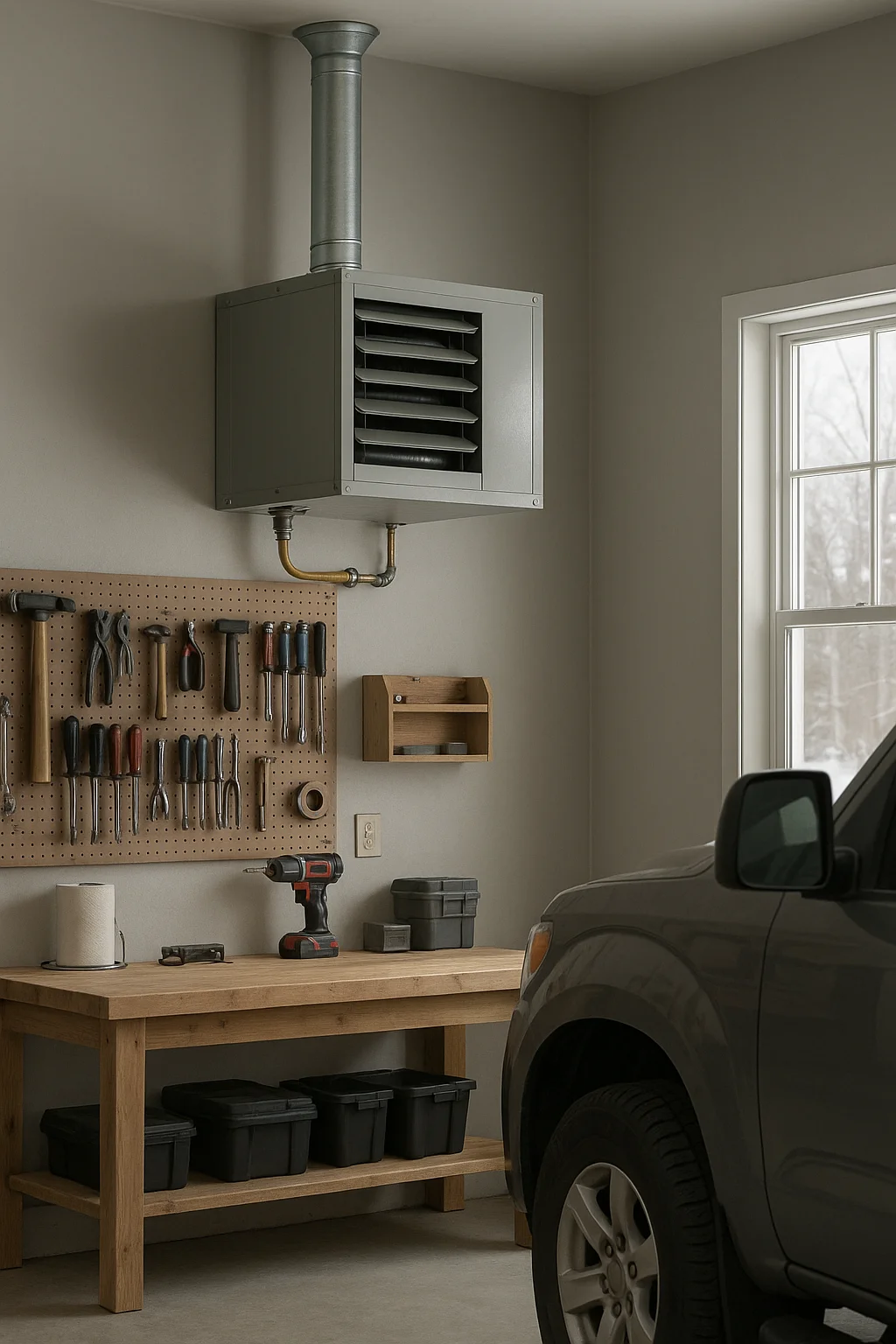
Almost every garage heater we install is a forced-air, gas-fired unit heater: a compact cabinet holding a burner, a heat exchanger and a fan, hung from the ceiling or mounted high on a wall, running on natural gas or propane. The fan pushes warm air down across the floor instead of letting it pool at the rafters, and a correctly sized unit will hold an insulated double garage at a working temperature through a −35 °C morning. Brands we install and service include Modine Hot Dawg, Reznor UDAP and UDX, Sterling, Lennox and Mr. Heater Big Maxx.
Unit heaters are the right tool for attached and detached residential garages, acreage shops through the County of Grande Prairie, and small commercial bays. Once a building gets tall — a high-bay shop, a truck bay, a warehouse — infrared tube heaters often deliver better comfort per dollar of gas, because they warm floors, equipment and people directly instead of heating a column of air that stratifies at the ceiling. If that describes your building, our radiant tube heater installation page covers that option.
Where there is no practical way to get gas to the building, a 240 V electric garage heater is a workable alternative for a smaller space. It needs a dedicated circuit and correctly sized conductors, and our licensed electricians handle that side. Anything with a burner in it is gas work: a permit, CSA B149.1 clearances, a compliant vent termination, and a combustion and carbon monoxide test before we hand it over.
Why Choose Us
Why Choose Indoor Elements For Garage Heater Installation
A garage heater is a small appliance that carries real consequences if it is sized, vented or gassed up incorrectly. You want the same standard of work you would expect on a furnace, from a contractor who will still be here when it needs service. Indoor Elements Mechanical is family-owned in Grande Prairie since 1991, and garage and shop heating is one piece of the residential and commercial heating work we do every week.



What We Fix
Common Garage Heater Repair Problems
Garage heaters sit idle all summer, then get asked to work hard the week the temperature drops. These are the faults we see most often, and what is usually behind them.
Igniter Or Ignition Control Failure
Modern unit heaters light with either a direct-spark electrode or a silicon carbide or silicon nitride hot surface igniter. Spark electrodes crack and lose their gap; hot surface igniters are brittle and degrade every heating season. Either way the symptom is the same — the fan runs, the burner never lights, and the board locks out after three tries. It is the most common no-heat call we get, and one of the fastest to fix.
Pilot Will Not Stay Lit
Older standing-pilot heaters use a thermocouple or thermopile to prove the flame and hold the gas valve open. When it weakens, the pilot lights, burns for thirty seconds, then drops out the moment you release the button. A drafty garage, a partly plugged pilot orifice, or an aged thermocouple all look the same, so we test millivolt output rather than guessing.
Dirty Flame Sensor And Short Burner Runs
On electronic ignition heaters, a flame sensor confirms the burner actually lit. Garages are dusty, and a sensor coated in oxide or drywall dust stops passing enough microamps for the board to see flame. The heater lights, runs a few seconds, then shuts the gas off and tries again. Cleaning or replacing the sensor and checking the ground path usually settles it.
Pressure Switch Faults And Blocked Venting
A power-vented unit heater will not open the gas valve until the pressure switch proves the inducer is moving air. A vent blocked by a bird or wasp nest, snow drifted against a sidewall termination, or a cracked pressure hose all trip the same fault. We treat every pressure switch complaint as a venting question first, because bypassing the switch is how carbon monoxide ends up in a garage.
Blower Motor And Fan Limit Problems
The fan is what moves heat off the exchanger and into the room. Worn bearings show up as a grinding or squealing noise long before the motor seizes, and a failed capacitor leaves the blower humming without turning. A fan limit control that has drifted causes the opposite problem — cold air blowing across the shop, or the heater tripping on high limit.
Short Cycling
A heater that fires for a minute, quits, and fires again is telling you something. Common causes are an oversized unit, a thermostat mounted in the wrong spot, restricted airflow across the heat exchanger, a marginal flame sensor, or low gas pressure at the manifold. Short cycling burns fuel and wears the igniter and gas valve, so it is worth diagnosing.
Gas Valve Faults And Gas Odour
A redundant gas valve that will not open, opens erratically, or leaks by will keep a healthy heater from producing heat. We verify inlet and manifold pressure with a manometer before condemning a valve, because low supply pressure looks identical from the thermostat. If you smell gas in the garage, leave the building and call the gas utility first, then call us.
Heater Runs But The Garage Stays Cold
Sometimes nothing is broken. The heater is undersized, or the building loses heat faster than the heater can add it — an uninsulated overhead door, an unsealed man door, bare rafters, a slab with no perimeter insulation. We calculate the actual heat loss and show you the numbers, then talk through a larger unit, a second heater, envelope work, or some combination.
Equipment Selection
Choosing The Right Gas Garage Heater
Three decisions decide whether a garage heater is a quiet success or a long-running annoyance: how it is sized, what kind of combustion and venting it uses, and how the gas and controls are set up around it.
Sizing And Heat Loss
The output rating on the box is BTU/h, and picking it off a square-footage chart is how most garages end up cold. A heat-loss calculation looks at floor area and ceiling height, insulation values, the overhead door and how well it seals, whether the slab has perimeter insulation, and how exposed the building is to wind. We run that against a −40 °C design temperature, because a heater sized for an average winter day has nothing left on the days you notice.
Power-Vented, Separated-Combustion Or Condensing
A power-vented heater takes combustion air from inside the garage and pushes exhaust out through a single vent. It is the common, economical choice for a clean garage. A separated-combustion unit — also called sealed-combustion or direct-vent — draws fresh air from outdoors through a second pipe, so the burner never breathes shop air. That matters in wood shops, welding bays, spray areas, and tight modern garages where the heater would otherwise compete with the building for air. Condensing high-efficiency unit heaters pull more heat from the same gas and vent in plastic pipe.
Venting, Gas Line And Controls
CSA B149.1 sets the clearances to combustibles around the cabinet and vent, and the distances a vent termination must keep from windows, doors, soffits, air intakes and the gas meter. The gas line has to be sized for the run and every appliance on it, so the heater still sees full manifold pressure when the furnace and water heater are firing. On propane, the unit needs the manufacturer conversion kit — different orifices and a regulator adjustment. Then the thermostat: line-voltage or low-voltage depending on the model, mounted away from the overhead door and off an exterior wall, and programmable so you can hold the shop at 5 °C and bring it up before you use it.
Our Process
How A Unit Heater Installation Runs
Most garage heater installations are a one-day job. Here is what that day looks like, from the first visit through the inspection.
Site Assessment And Quote
We measure the building, check insulation and the overhead door, find where the gas line can come from and what else is on it, and look at where a vent can terminate legally. That gives us a heat loss number, a heater size, and a written quote covering the unit, gas line, venting, wiring, thermostat and permit. Estimates are free.
Installation Day
The heater is hung from structure that will carry it, at the right height and angle for the space, with full clearance to combustibles. We run and pressure-test the gas line with a shutoff and drip leg at the unit, install the vent to the manufacturer's instructions, and wire the power and thermostat.
Commissioning And Safety Testing
We fire the heater, verify inlet and manifold gas pressure with a manometer, watch a full ignition and shutdown cycle, confirm the vent is drawing, and run a carbon monoxide test in the space. Clearances get checked against the rating plate, and we set and explain the thermostat before we pack up.
Permit, Inspection, Warranty And Cleanup
The gas permit is pulled before the work starts and the inspection is booked when it is done. We register the manufacturer warranty in your name and hand over the paperwork. Packaging and the old heater leave with us, and the garage is swept before we go.
Paying For It, And Keeping It Running
A garage heater is a smaller project than a furnace, but it is still a purchase. If it is easier to spread the cost over monthly payments, we can walk you through our financing options on approved credit.
A unit heater then asks very little: a clean burner and flame sensor, a vent checked for nests and snow, a look at the blower and gas pressure, and a carbon monoxide test each year. Most owners fold that into their annual HVAC maintenance visit. We also recommend a working carbon monoxide detector in every heated garage, and in the adjoining rooms of an attached garage.
Trust & Experience
Grande Prairie's Garage And Shop Heating Specialists
We have hung unit heaters in new attached garages in town, in forty-year-old detached garages behind older homes, and in shops on acreages where the nearest gas line was a long way from the heater. The difference between a heater that works and one that disappoints is almost always in the planning rather than the equipment.
Indoor Elements Mechanical has been family-owned in Grande Prairie since 1991. We are licensed and insured, WCB covered and COR certified, and the same technicians who install your heater are the ones who come back to service it.
Thirty Years Of Peace Country Gas Work
Unit heaters, furnaces, boilers, fireplaces and shop heating — we have been doing licensed gas work in and around Grande Prairie since 1991, on both natural gas and propane.
Sized For A −40 °C Design Temperature
Equipment sized for a milder climate leaves you short on the days it matters. We size against local design conditions and the actual condition of your building, not a national average.
Licensed, Insured And Permitted
Licensed Alberta gas fitters, full liability insurance, WCB coverage and COR certification. Every gas-fired heater we install is permitted and inspected under the Alberta Safety Codes Act.

What Our Customers Say
Trusted For Garage And Shop Heating
“During the estimate process I felt all my questions and concerns were heard and addressed. All 3 techs that came on site were efficient and knowledgeable of the job to be done. Very respectful of our home. So appreciative to have A/C”
Lorna Sheehan
August 2026
“Fantastic to collaborate with Indoor Elements for a whole home back up generator installation along side our grid tied solar system project. They handled their end of the deal in a efficient professional manner. From the owner to the office to the field techs, everyone was a pleasure to work with an hope to partner again on projects moving forward.”
Chris Jacobson
August 2026
“The service technician did a great job . He quickly found the issue and while completing the repair was able to answer any questions I had. Also before leaving left me with a few “good to knows” quick tips which is much appreciated. We have used Indoor Elements before and will definitely use them again.”
lawrence turick
July 2026
“Indoor elements installed a new high efficiency furnace and heat pump in our home. From coming and doing the estimate to final checks, they were professional, friendly and efficient. Luke was very thorough in providing an accurate estimate of our needs and broke things down in three easy to understand options to consider. All four installers produced a clean, organized final product. Now we just need some warm summer days so we can fully enjoy our newly air conditioned home.”
Kevin Bain
June 2026
“Exceptional work. Always professional. Gives me peace of mind knowing all my systems are looked after. I always recommend indoor elements”
Dan Student
June 2026
“The team from Indoor Elements are well skilled in their chosen field, are always on time, and will answer any questions. I would recommend them.”
Janeen. Knapp
May 2026
“They answer your call right away and the service was great.”
sam dayo
May 2026
“Recently had a furnace installed by indoor elements after having furnace issues, their prices were very competitive compared with other venders in the city, They were very knowledgeable and did a great job installing everything and were very professional the entire time and answered all my questions and then some. Would recommend them for all your furnace and Machanic needs. Happy with the service provided so far. EDIT had them instal my AC system and again service was great and install was great , I had a bit of a challenging install due to the furnace room location, but still was able to make it work no problem. The install was alot cleaner then compeditors installs I had done in other houses, and more attention to detail was taken.”
Tyler M
May 2026
“Fast and reliable service!”
Shirley McKeever
April 2026
Service Coverage
We Come to You
We install and repair garage and shop heaters throughout Grande Prairie and the surrounding Peace Country, on both natural gas and propane.
Grande Prairie — attached and detached garages in every neighbourhood, plus commercial bays and service shops
County & Acreages — shop and quonset heating throughout the County of Grande Prairie, including propane installations
Peace Country — Clairmont, Sexsmith, Wembley, Beaverlodge, and the surrounding communities
New builds and retrofits — heaters roughed in during construction, or added to a garage that has gone unheated for years
Get The Garage Warm
Ready For A Heated Garage This Winter?
Whether you are putting a unit heater in for the first time or your old one quit on the coldest night of the year, our licensed gas fitters can help. Call for a free estimate or an emergency repair.
FAQ