
Commercial & Shop Heating
Radiant Tube Heater Installation
Grande Prairie
A gas-fired radiant tube heater warms the floor, the equipment and the people under it instead of trying to heat a 25-foot column of air. In a Grande Prairie shop with the overhead door up half the morning, that difference is the whole point. Indoor Elements Mechanical has been designing, installing and servicing low-intensity infrared tube heaters across the Peace Country since 1991.
Sized for your building, installed by licensed Alberta gas fitters, permitted and inspected.


How It Works
How Infrared Tube Heaters Heat A Shop
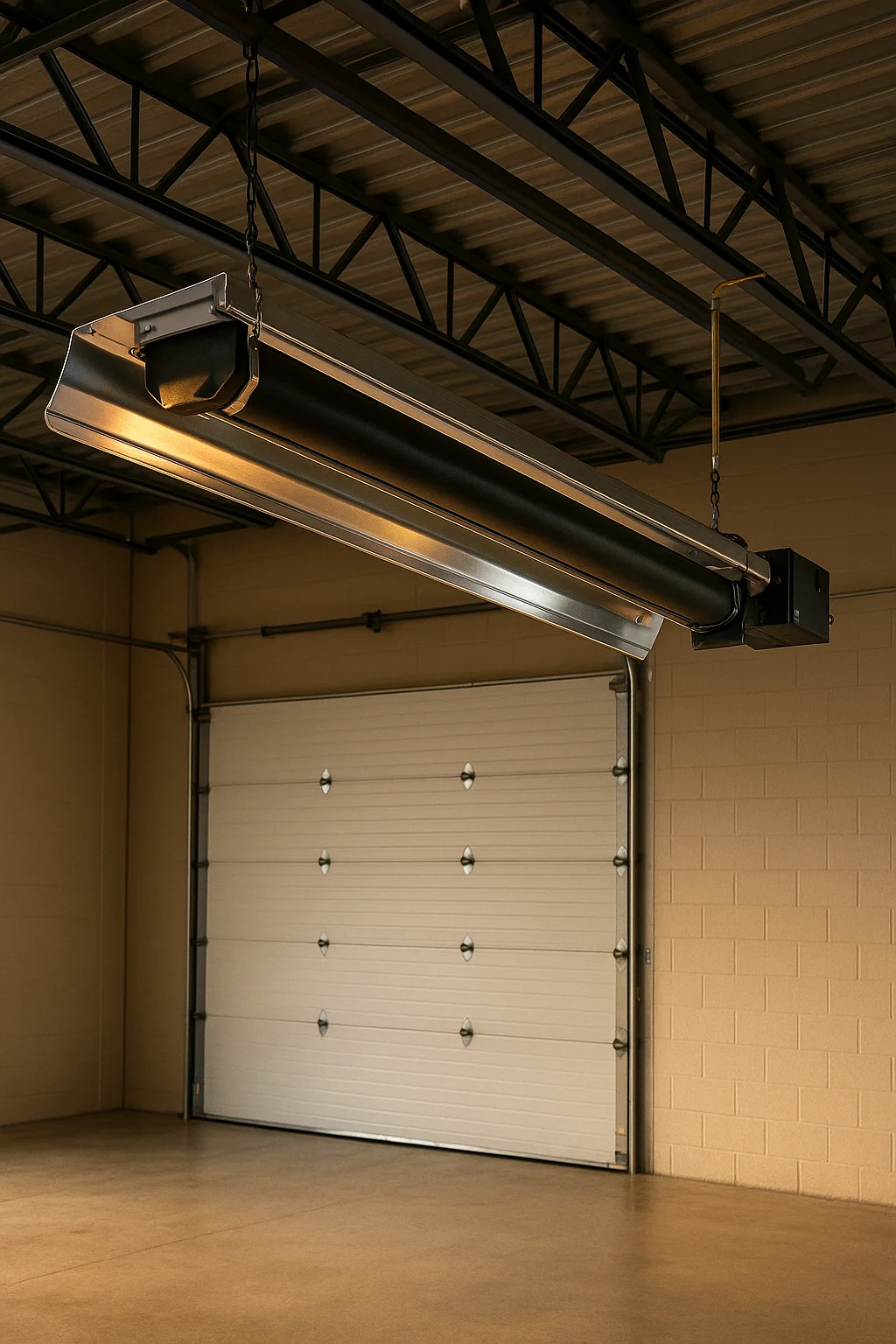
A low-intensity radiant tube heater is a burner firing down a length of steel emitter tube with a reflector hung above it. The tube heats up, the reflector aims that infrared energy at the floor, and the energy passes through the air almost untouched until it lands on something solid. Your slab, your benches, your racking, your trucks and the people working around them absorb it and warm up. Those warm surfaces then give heat back to the space, which is why a radiant-heated shop feels comfortable at a lower thermostat setting than a forced-air one.
That changes the arithmetic in a high-bay building. Forced air heats the air first, and warm air goes to the ceiling, so a shop with 24-foot trusses can be well above the setpoint at the deck while the floor is still cold. Radiant heat cuts that stratification down, and it recovers fast when a door opens because the concrete and the steel under the heater never lost their energy in the first place. Operators moving from forced air to radiant in high-ceiling spaces often report meaningful fuel savings, and the comfort difference at the floor is usually noticed first.
Almost everything we install is a low-intensity vented tube heater, where combustion happens inside the tube and the exhaust is vented outside the building. High-intensity ceramic plaque heaters run much hotter, are typically unvented and belong in specific spot-heating applications with the ventilation to match. And if the space in question is a smaller attached residential garage, a forced-air unit heater is usually the right call instead. That is a different job, and it is covered on our garage heater installation page.
Why Choose Us
Why Choose Indoor Elements For Commercial Radiant Heating
Hanging a tube heater is the easy part. Getting the sizing, the layout, the gas piping and the venting right is what decides whether a shop is comfortable in January or whether you spend the next ten years fighting it. We have been doing this work in industrial buildings around Grande Prairie for over three decades, as one part of the heating, cooling and ventilation lineup we bring to local shops.



What We Handle
Where Radiant Tube Heaters Excel, And What We Fix
Some of these are reasons to put infrared heat in a building. The rest are the service calls we get on tube heaters that are already hanging. We do both.
High-Ceiling Shops That Never Feel Warm
In a shop with 20 to 30 foot ceilings, forced air sends most of your heat straight to the deck and leaves a wide temperature gradient between the trusses and the floor. Radiant tube heaters warm the slab, the benches and the equipment instead of the air column, so the working level comes up without paying to keep the ceiling hot.
Overhead Doors Open All Day In January
Every time a truck bay door rolls up at minus 30, a forced-air system loses the warm air it just made and starts over. With radiant heat, the concrete, tooling and vehicles hold energy through the door cycle, so the space recovers in minutes instead of most of an hour.
Spot Heating Over Work Bays And Wash Bays
You rarely need an entire warehouse at the same temperature. We can aim radiant heat over service bays, welding stations, parts counters and car wash bays and leave dead storage cooler, which is often where the biggest fuel savings on a building come from.
Drafty Buildings And Cold Concrete Floors
Older steel buildings, ag shops and pole barns leak air faster than a forced-air system can replace it. Because infrared energy is absorbed by surfaces rather than carried by air, radiant tube heaters keep working in a building that will never be airtight, and a warm slab makes a shop feel comfortable at a lower air temperature.
Frozen Equipment, Vehicles And Stored Product
Hydraulics, adhesives, paint, coolant and livestock water lines all care about surface temperature, not air temperature. Radiant heat over equipment rows, loading docks and livestock pens keeps machinery ready to run and product usable through a Peace Country cold snap.
Heater Will Not Ignite Or Keeps Locking Out
A tube heater that clicks and quits usually comes down to a short list: a pressure switch that is not proving, a cracked or shorted igniter, a dirty flame rod losing flame signal, a failed gas valve, or a control board fault. We diagnose it properly with a manometer and a meter rather than swapping parts and hoping.
Burner Short Cycling Or Blocked Vent And Intake
Short cycling burns through igniters and gas valves and wastes fuel. It often traces back to a restricted exhaust or combustion air intake, a bird or wasp nest in a side-wall termination, undersized gas piping causing pressure drop, or a thermostat mounted where radiant energy hits it directly.
Sagging Tubes, Damaged Reflectors And Vacuum Pump Failures
Emitter tubes discolour, scale and eventually sag when a heater has been overfiring or hanging on failed supports. Dented or corroded reflectors throw energy in the wrong direction, and on multi-burner vacuum systems a tired vacuum pump takes the whole run of heaters down at once. We replace tubes, hangers, reflectors and pumps rather than condemning a system that still has life in it.
Equipment Selection
Specifying A Gas Radiant Heater For Your Building
Three decisions decide how a radiant system performs: how much input you hang and how high, how the tubes and burners are arranged, and how the thing is vented and controlled. We work through all three before anything is ordered.
Sizing And Mounting Height
We start with a heat-loss calculation for the building: wall and roof construction, insulation values, glazing, overhead door area and how often those doors cycle. That gives us the BTU/h you need. Mounting height then sets how that input is delivered, because the higher a heater hangs, the larger the area it covers and the more input it takes to reach the same intensity at the floor. We check the listed clearances to combustibles for the model, plus real-world obstructions like hoists, cranes, lifts, racking and the swing of an open overhead door, before we commit to a height.
Tube Configuration And Burner Staging
A straight or linear run suits a long bay or a row of work stations. A U-tube folds the same emitter length into half the space, which is often the answer in a shorter shop or over a single service bay. Burners come single-stage, two-stage or fully modulating, and on larger buildings a multi-burner vacuum system can run several burners off one common vacuum pump on a continuous tube run. Turbulators inside the tube even out surface temperature, and the reflector matters more than people expect: aluminum and polished reflectors, plus end caps and side shields, decide how much of your fuel ends up on the floor instead of the ceiling.
Venting, Clearances And Controls
Every heater we hang is certified to ANSI Z83.20 / CSA 2.34 and installed to CSA B149.1 for clearances, gas piping and venting. We decide between side-wall and roof termination based on the building, bring in dedicated combustion air where the space is tight or under negative pressure, and size the gas line and regulator for natural gas or propane so the manifold pressure holds when everything fires at once. Controls range from a simple line-voltage thermostat to zoned setback controllers or a tie-in to your building automation. Shops running vehicle or welding exhaust also need air coming back in, which is where make-up air unit service becomes part of the same conversation.
Our Process
From Site Survey To Commissioned System
A radiant tube heater install is a planned job, not a same-day swap. Here is how we run one, from the first walk through your shop to the day the permit is signed off.
Site Survey And Heat-Loss Review
We walk the building with you. Ceiling height, construction and insulation, door sizes and how often they open, where the work actually happens, what hangs from the ceiling already, and what gas and electrical service is available. That walk plus a heat-loss calculation gives us the BTU/h and the layout constraints to work with.
Layout, Equipment Selection And Written Quote
You get a layout showing heater locations, tube configuration, mounting heights, vent terminations and zoning, along with the equipment we are proposing and why. The quote breaks out the heaters, hanging hardware, gas piping, venting, electrical, controls and permit so nothing shows up as a surprise later.
Installation
Hangers and chain go into structure that will carry them, then the emitter tubes, reflectors and burner sections are assembled to the manufacturer's instructions. We run and pressure-test the gas piping, set the regulator, complete the vent and combustion air terminations, and make the electrical connections and thermostat wiring. Where possible we work around your production schedule instead of shutting the shop down.
Commissioning, Inspection And Warranty
We fire each heater, check manifold and supply gas pressure with a manometer, verify the vacuum or combustion settings, confirm safeties and flame signal, and set up the thermostats or zone controls. Then the Alberta gas and electrical permits get inspected, the warranty is registered in your name, and we hand over the manuals and the layout drawing for your records.
Annual Service And The Rest Of The Building
Tube heaters live in dusty, greasy air and run long hours through a Peace Country winter, so they need a look once a year. A service visit covers burner and igniter condition, flame signal, gas pressure, the vent and combustion air terminations, tube alignment and support, reflector condition, controls and safeties, and on vacuum systems the pump itself. That work fits naturally into a scheduled commercial HVAC maintenance program alongside the rest of your equipment.
Most shops need more than heaters. We also handle rooftop units, make-up air, ventilation, ductwork, boilers and controls for full commercial buildings, so a radiant install can be one part of a larger plan rather than a stand-alone project. You can see the full scope of our commercial HVAC services if your building needs more than heat.
Trust & Experience
Grande Prairie's Shop Heating Specialists
Oilfield service shops, truck and equipment bays, warehouses, hangars, arenas, car washes and ag buildings all get heated differently, and most of them are in the wrong hands when a general contractor treats infrared like a bigger unit heater. We have hung and serviced radiant tube heaters in these buildings around Grande Prairie for over thirty years and we know how they behave at minus 40.
Family-owned since 1991, licensed and insured, WCB covered and COR certified. We do the design, the gas fitting, the venting and the electrical with our own people, and we are still here to service what we install when it needs attention five or ten winters from now.
Three Decades In Industrial Buildings
We have been heating shops, warehouses and ag buildings in the Peace Country since 1991, across every common low-intensity infrared brand and every configuration from a single U-tube to a multi-burner vacuum system.
We Design For Our Own Winters
Sizing that works in a milder city falls apart in a Grande Prairie shop with the door open all day in January. We build in the recovery capacity a Peace Country winter actually demands rather than a number off a chart.
Permitted, Inspected And Insured
Licensed Alberta gas fitters, permits pulled under the Safety Codes Act, inspections booked, full liability insurance and WCB coverage. You get documented, code-compliant work, which matters to your insurer as much as it does to us.

What Shop And Building Owners Say
Trusted by Grande Prairie Businesses
“During the estimate process I felt all my questions and concerns were heard and addressed. All 3 techs that came on site were efficient and knowledgeable of the job to be done. Very respectful of our home. So appreciative to have A/C”
Lorna Sheehan
August 2026
“Fantastic to collaborate with Indoor Elements for a whole home back up generator installation along side our grid tied solar system project. They handled their end of the deal in a efficient professional manner. From the owner to the office to the field techs, everyone was a pleasure to work with an hope to partner again on projects moving forward.”
Chris Jacobson
August 2026
“The service technician did a great job . He quickly found the issue and while completing the repair was able to answer any questions I had. Also before leaving left me with a few “good to knows” quick tips which is much appreciated. We have used Indoor Elements before and will definitely use them again.”
lawrence turick
July 2026
“Indoor elements installed a new high efficiency furnace and heat pump in our home. From coming and doing the estimate to final checks, they were professional, friendly and efficient. Luke was very thorough in providing an accurate estimate of our needs and broke things down in three easy to understand options to consider. All four installers produced a clean, organized final product. Now we just need some warm summer days so we can fully enjoy our newly air conditioned home.”
Kevin Bain
June 2026
“Exceptional work. Always professional. Gives me peace of mind knowing all my systems are looked after. I always recommend indoor elements”
Dan Student
June 2026
“The team from Indoor Elements are well skilled in their chosen field, are always on time, and will answer any questions. I would recommend them.”
Janeen. Knapp
May 2026
“They answer your call right away and the service was great.”
sam dayo
May 2026
“Recently had a furnace installed by indoor elements after having furnace issues, their prices were very competitive compared with other venders in the city, They were very knowledgeable and did a great job installing everything and were very professional the entire time and answered all my questions and then some. Would recommend them for all your furnace and Machanic needs. Happy with the service provided so far. EDIT had them instal my AC system and again service was great and install was great , I had a bit of a challenging install due to the furnace room location, but still was able to make it work no problem. The install was alot cleaner then compeditors installs I had done in other houses, and more attention to detail was taken.”
Tyler M
May 2026
“Fast and reliable service!”
Shirley McKeever
April 2026
Service Coverage
We Come to You
We install and service radiant tube heaters throughout Grande Prairie and the surrounding Peace Country, from single-bay shops to full industrial buildings.
Grande Prairie — Richmond Industrial and the city's other industrial parks, plus warehouses, service shops and commercial bays across town
Clairmont & Crossroads — oilfield service shops, truck and equipment bays, and yard buildings north of the city
County & Rural — farm shops, machinery storage, livestock buildings and acreage shops throughout the County of Grande Prairie, on natural gas or propane
Peace Country — Sexsmith, Wembley, Beaverlodge and surrounding communities
Get The Shop Warm
Book Your Radiant Heat Site Survey
Whether you are heating a new shop, replacing tired tube heaters or need a system back online today, Indoor Elements Mechanical can help. Call for a site survey, a written quote, or 24/7 service on the heaters you already have.
FAQ