
Hydronic Radiant Heating
In-Floor Heating Installation
Grande Prairie
In-floor heating turns the floor itself into the heat source. Warm water moves through tubing cast into the concrete or fastened under the subfloor, and the whole surface gives off steady, even heat. No registers blowing air, no cold corners along the exterior walls, nothing taking up floor space. Indoor Elements Mechanical has been designing and installing hydronic radiant floor heating in Grande Prairie since 1991.
A warm slab is what turns a shop into a space you actually use in January.


How It Works
How Hydronic Radiant Floor Heating Works
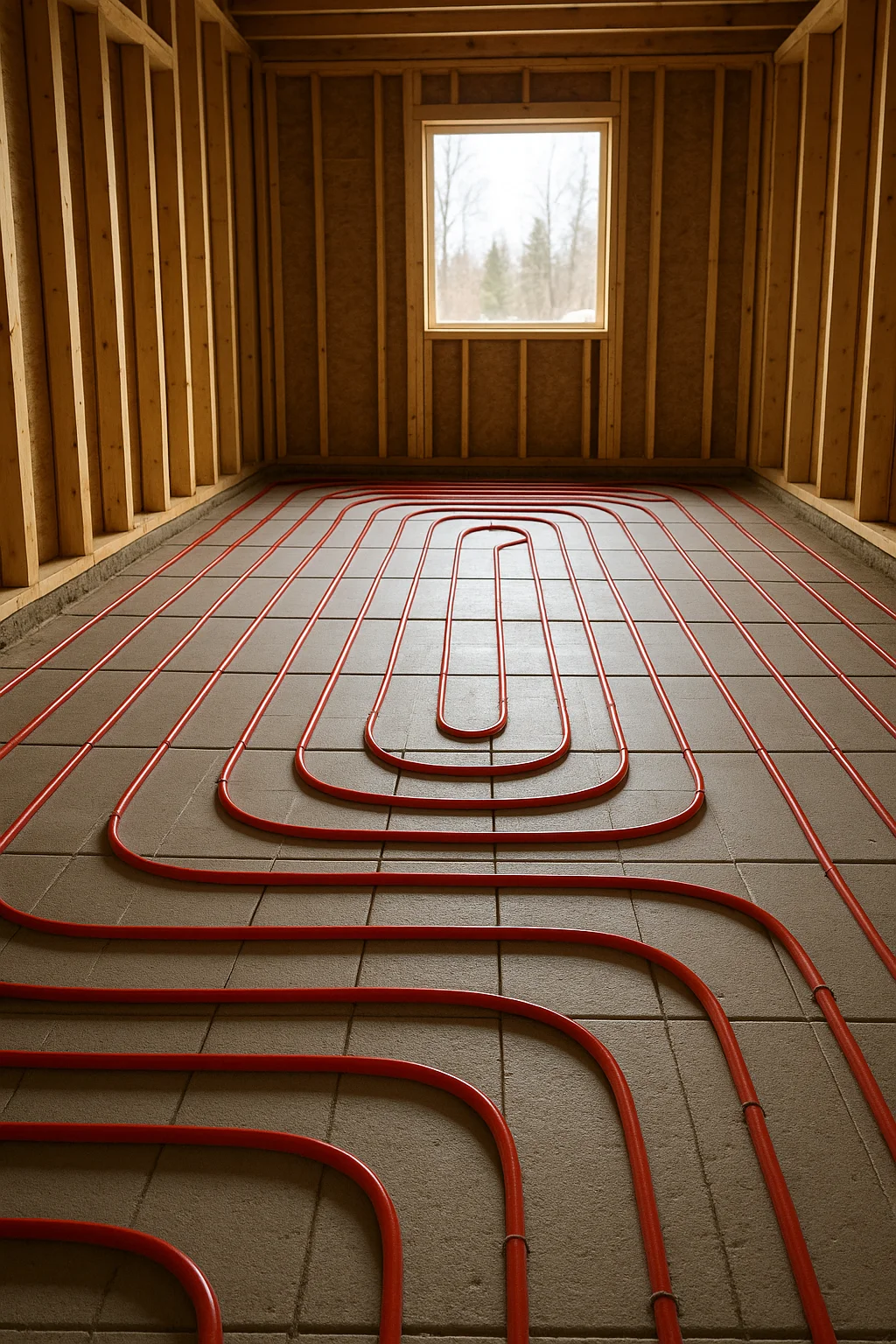
A hydronic in-floor system is a closed loop of warm water. A circulator pushes it out to a manifold, the manifold splits it into individual loops of oxygen-barrier PEX running through the floor, and the floor releases that heat slowly across its whole surface. Because the emitting surface is so large, the water never needs to be hot: a well-insulated slab is usually comfortable on supply water around 30 to 50 °C, far below what baseboard or radiators need.
The rest of the system lives in the mechanical room. A mixing valve blends boiler water down to what the floor wants, flow meters and balancing valves set the flow in each loop, and zone actuators open and close loops as thermostats call, so the house, the ensuite, and the shop each hold their own temperature.
The heat source is almost always a boiler, and radiant floors are the best possible match for a condensing one, because the cool water a floor returns is what lets it condense and run at peak efficiency. Our boiler installation page covers that side of the system. For one small area, a bathroom or an entry floor where a water loop is more trouble than it is worth, an electric radiant mat under the tile is often simpler, and our licensed electricians install those. Everything else on this page is about the water side.
Why Choose Us
Why Choose Indoor Elements For In-Floor Heating
In-floor heating is unforgiving work, because most of it disappears under concrete. Once the slab is poured, the spacing, loop lengths, insulation, and tubing quality are permanent. Indoor Elements Mechanical has been getting that stage right in the Peace Country since 1991, alongside the furnaces, boilers and heat pumps we install across the region.



Where It Fits
Where In-Floor Heating Makes Sense
Radiant floors are not the right answer everywhere, but in a climate with design temperatures near −40 °C and frost that drives deep into the ground, there are places they are hard to beat.
New Home Construction
The cheapest time to install in-floor heat is before the concrete is placed. On a new build we work from the plans, insulate under the slab, lay out the loops room by room, and set the manifolds while the walls are open. Basement slab heat is the usual starting point, and many homeowners carry it into main-floor tile and ensuites.
Heated Garage And Shop Slabs
This is what most people call us about. A heated slab warms a garage or shop from the floor up, so the space stays usable at −40 °C with nothing roaring overhead. It dries vehicles fast, keeps the floor comfortable to work on, and leaves the walls and ceiling clear for shelving, hoists, and overhead doors.
Basement Finishing
Basements are the coldest rooms in most Peace Country homes because the slab sits on ground that never really warms up. Heating the slab fixes that at the source instead of fighting it with extra registers. Where the slab is already poured, a thin-slab overpour or a staple-up system from below are the practical routes.
Bathrooms And Ensuites
Tile conducts heat beautifully, which is exactly why it feels so cold underfoot. A single loop under a bathroom or ensuite floor makes it the most comfortable room in the house on a January morning. Bathrooms are usually zoned on their own so the floor can be warm without overheating the room.
Acreage Homes And Outbuildings
Acreages around Grande Prairie, Clairmont, Sexsmith, and Wembley often heat a house, a shop, and sometimes a garage suite from one mechanical room. Hydronic handles that well: separate zones off a shared manifold and boiler, each with its own thermostat and schedule.
Additions And Bonus Rooms
Rooms added onto an existing house are hard to heat with the original furnace, especially bonus rooms over a garage. In-floor heat gives the addition its own zone and thermostat, so it holds temperature independently instead of relying on ductwork that was never sized for it.
Homes With Allergy And Dust Concerns
Radiant floors heat without moving air, so they do not push dust, dander, and pollen through the house the way forced air does. For households dealing with allergies or asthma, that difference is noticeable. The system is also silent, with no blower cycling on and off overnight.
Commercial And Institutional Floors
Showrooms, vet clinics, warehouses, shop bays, and equipment dealerships all benefit from a heated floor. Nothing hangs from the ceiling, vehicles track snow in without leaving ice, and the heat stays down where people and animals are instead of stratifying at the roof deck.
System Design
Three Decisions That Shape Your Radiant Floor System
How the floor is built, how the tubing and zoning are laid out, and how the water is heated and controlled. Get those three right and the system quietly does its job for decades.
Floor Construction Method
A slab-on-grade pour is the best version of in-floor heating and the one we build most often. Rigid insulation and a vapour barrier go down over compacted fill, edge insulation keeps the slab from wicking heat into frozen ground, and the tubing is tied to rebar or wire mesh, or stapled to the foam, before the concrete goes in. Over an existing floor, a thin-slab overpour of gypsum or lightweight concrete adds heat for about an inch and a half of added height, and where nothing can be poured, a staple-up system runs tubing and aluminum heat-transfer plates through the joist bays from below. For a finished garage where the slab is staying put, a garage heater installation is usually more practical.
Tubing, Manifolds And Zoning
We install oxygen-barrier PEX in half-inch and five-eighths-inch sizes, PEX-A or PEX-B depending on the layout, meeting ASTM F876 and F877 with a DIN 4726 barrier. Spacing typically runs six to twelve inches on centre, tighter along exterior walls and under overhead doors where heat loss is highest. Loops go in as a serpentine or a counter-flow spiral, which alternates supply and return runs so the floor stays even instead of hot at one end, and each is kept short enough to balance properly. Every loop lands on a manifold with flow meters and balancing valves, from brands we install including Uponor, Rehau, Viega, and Watts, with zone actuators and thermostats grouping the floors to match how the building is used.
Heat Source, Controls And Water Temperature
Most systems we build are fed by a high-efficiency condensing boiler, and we install and service brands including NTI, IBC, Viessmann, Navien, and Lochinvar. A mixing valve sets the supply temperature the floor needs, lower for a slab and higher for staple-up through a wood subfloor, and an outdoor reset control slides that temperature with the weather so the floor stays ahead of a cold snap. Grundfos and Taco circulators move the water, an expansion tank absorbs the pressure change, an air separator pulls out trapped air, and propylene glycol protects anything that could freeze. Snow-melt for a driveway apron runs off the same mechanical room, now or roughed in for later.
The Installation
How An In-Floor Heating Installation Runs
An in-floor project happens in two visits separated by other trades: the rough-in before the concrete or the flooring, and the mechanical room once the building is closed in.
Design And Heat-Loss Calculation
We start with a room-by-room heat loss based on your plans or the existing building: insulation values, window area, ceiling height, overhead doors, and our local design temperature. From that comes a loop layout drawing showing tube spacing, loop lengths, manifold locations, and zone boundaries, along with the boiler output in BTU/h the system needs. You see the drawing before anything is ordered.
Rough-In, Tubing And Pressure Test
On a slab, under-slab rigid insulation, the vapour barrier, and edge insulation go in first, then tubing is rolled out to the drawing and tied to rebar or wire mesh at consistent spacing. Manifolds get set and the loops are pressurized, usually between 60 and 100 psi, and held on the gauge through the pour, so if a boot or a rebar tie damages a line we know that hour instead of after the concrete cures.
Mechanical Room, Boiler And Controls
Once the building is closed in, we build the mechanical room: boiler set and vented, gas line run and pressure tested, near-boiler piping, circulators, mixing valve, expansion tank, and air separator assembled, and the manifolds piped back to the plant. Thermostats, zone actuators, and the outdoor reset sensor get wired and configured, along with an indirect tank if the boiler is also making domestic hot water.
Commissioning, Balancing, Permits And Warranty
We fill and purge the system loop by loop, charge glycol where it is needed, set flow on every circuit at the manifold, and bring the slab up to temperature gradually rather than all at once. Then we set the mixing valve and reset curve, verify combustion and venting, walk you through the controls, and close out the plumbing and gas permits with the inspections booked.
Timing, Coordination And Financing
The most important thing about an in-floor project is being early. Bring us in while the plans are still being drawn and the concrete date is still flexible, and the design, the insulation detail, and the manifold locations get settled without pressure. We work directly with Grande Prairie builders and concrete crews, and on acreages and shops around the County of Grande Prairie, Clairmont, Sexsmith, Wembley, and Beaverlodge we plan around gravel, weather, and access the same way.
An in-floor system is a real investment, and the tubing outlasts the equipment that feeds it, so we would rather talk about cost openly and early. Estimates are free and written out in detail. We also offer residential financing options on approved credit that can spread the project into monthly payments, and high-efficiency condensing boilers sometimes qualify for manufacturer rebates or utility incentives.
Trust & Experience
Grande Prairie's Radiant Heating Installers
In-floor heating is the one mechanical system you cannot go back and fix. Once the concrete is down, the tubing, the spacing, and the insulation under it are there for the life of the building. That is why homeowners and builders here hire a company that has done this work in Grande Prairie for over thirty years.
We are a family-owned company that has been in the Peace Country since 1991, licensed and insured with WCB coverage and COR certification. Our gas fitters and plumbers do the tubing, the boiler, the gas, and the controls, so there is one number to call and one crew accountable for the finished floor.
Three Decades Of Hydronic Work
We have laid tubing in house slabs, shop floors, basements, and commercial buildings across Grande Prairie since the 1990s, and we still service systems we installed twenty years ago.
Designed For A −40 °C Winter
Under-slab insulation, edge insulation, tighter spacing at overhead doors, and glycol in anything that could freeze are not upsells here. They are what a Peace Country winter and our frost depth require.
Licensed, Permitted And Inspected
Plumbing and gas permits pulled under the Alberta Safety Codes Act, boiler gas fitting to CSA B149.1, inspections booked, and CSA-certified equipment throughout. Every technician holds current Alberta licensing.

What Our Customers Say
Trusted by Grande Prairie Homeowners And Builders
“During the estimate process I felt all my questions and concerns were heard and addressed. All 3 techs that came on site were efficient and knowledgeable of the job to be done. Very respectful of our home. So appreciative to have A/C”
Lorna Sheehan
August 2026
“Fantastic to collaborate with Indoor Elements for a whole home back up generator installation along side our grid tied solar system project. They handled their end of the deal in a efficient professional manner. From the owner to the office to the field techs, everyone was a pleasure to work with an hope to partner again on projects moving forward.”
Chris Jacobson
August 2026
“The service technician did a great job . He quickly found the issue and while completing the repair was able to answer any questions I had. Also before leaving left me with a few “good to knows” quick tips which is much appreciated. We have used Indoor Elements before and will definitely use them again.”
lawrence turick
July 2026
“Indoor elements installed a new high efficiency furnace and heat pump in our home. From coming and doing the estimate to final checks, they were professional, friendly and efficient. Luke was very thorough in providing an accurate estimate of our needs and broke things down in three easy to understand options to consider. All four installers produced a clean, organized final product. Now we just need some warm summer days so we can fully enjoy our newly air conditioned home.”
Kevin Bain
June 2026
“Exceptional work. Always professional. Gives me peace of mind knowing all my systems are looked after. I always recommend indoor elements”
Dan Student
June 2026
“The team from Indoor Elements are well skilled in their chosen field, are always on time, and will answer any questions. I would recommend them.”
Janeen. Knapp
May 2026
“They answer your call right away and the service was great.”
sam dayo
May 2026
“Recently had a furnace installed by indoor elements after having furnace issues, their prices were very competitive compared with other venders in the city, They were very knowledgeable and did a great job installing everything and were very professional the entire time and answered all my questions and then some. Would recommend them for all your furnace and Machanic needs. Happy with the service provided so far. EDIT had them instal my AC system and again service was great and install was great , I had a bit of a challenging install due to the furnace room location, but still was able to make it work no problem. The install was alot cleaner then compeditors installs I had done in other houses, and more attention to detail was taken.”
Tyler M
May 2026
“Fast and reliable service!”
Shirley McKeever
April 2026
Service Coverage
We Come to You
We install in-floor heating throughout Grande Prairie and the surrounding Peace Country, on new builds, renovations, acreages, and commercial projects alike.
Grande Prairie — new-build neighbourhoods, basement developments, garage slabs, and bathroom renovations across the city
County & Rural — acreage homes, heated shops, garages, and outbuildings throughout the County of Grande Prairie
Peace Country — Clairmont, Sexsmith, Wembley, Beaverlodge, and surrounding communities
Builders & commercial — new construction, additions, showrooms, clinics, and warehouse floors, scheduled around your pour
Warm Floors, Even Heat
Plan Your In-Floor Heating System
Whether it is a new home, a basement, or a shop slab you want warm next winter, the best time to talk is before the concrete date is set. Contact us for a free estimate and a loop layout built for your building.
FAQ